Posture & Back Fatigue
You Didn't Buy the Wrong Chair. You Bought the Wrong Category.
Men are spending four figures on furniture to fix a problem that follows them out of the room. Here's what physiotherapy principles actually say about why the ache comes back at 6 PM.
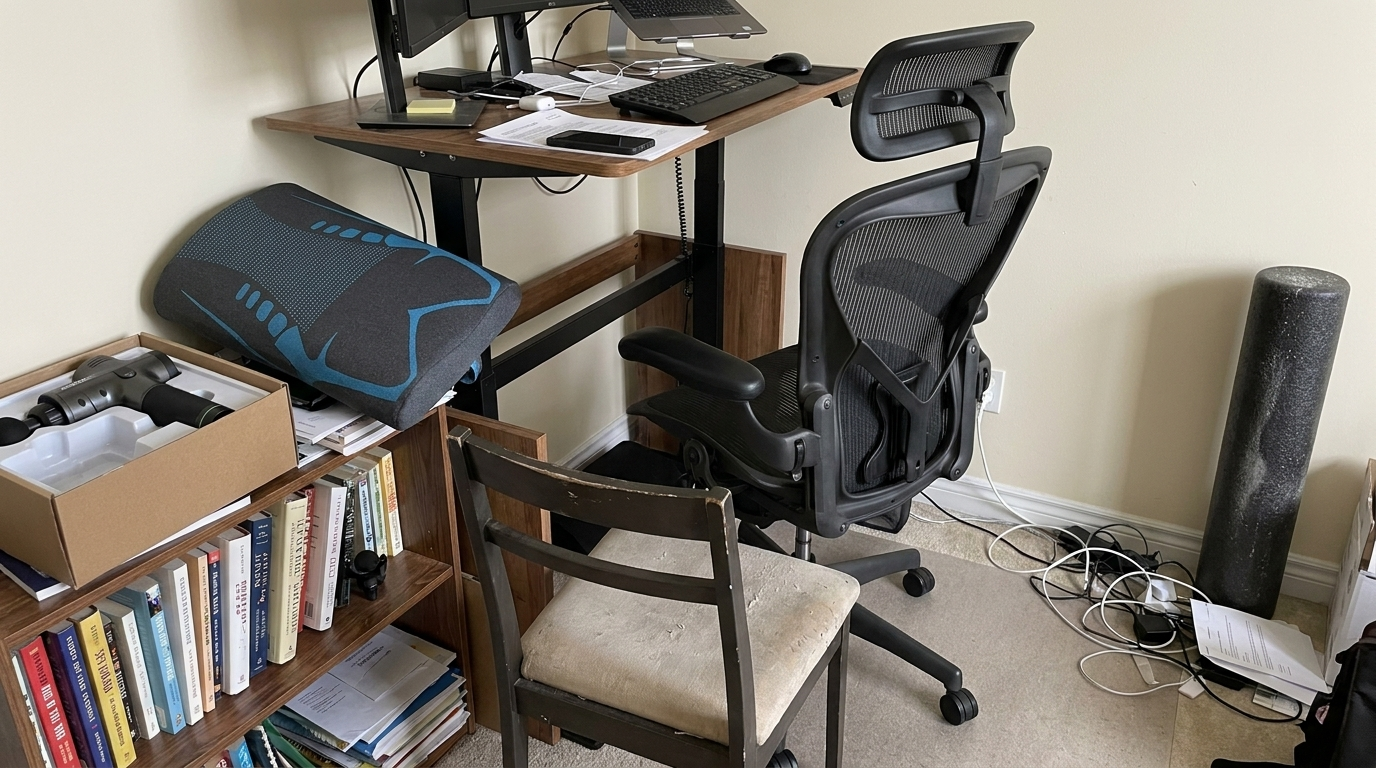
Do the receipts with me. The ergonomic chair: $400. The electric standing desk: $1,200. The lumbar pillow that came highly reviewed. The massage gun you used twice, maybe three times, before it went in the drawer next to the foam roller you also don't use. Add the chiropractor visits at $65 a pop. You are, by any reasonable accounting, a man who has taken his back seriously.
And still: it's 6 PM. Your lower back is tight in that specific band just above the belt line. Your shoulders have crept forward again. There's that hot, grinding ache between the shoulder blades that shows up around the fourth hour and never fully leaves. You stand up, you roll your neck, you hear something, and you tell yourself you'll stretch tonight. You won't.
Here's the uncomfortable part. None of that money was wasted on bad products. The chair is a good chair. The desk is a good desk. The problem is that you bought the wrong category of solution entirely.
The problem isn't where you sit. It's that your torso gets zero feedback for nine hours straight.
Every piece of gear on that receipt shares one fatal design flaw: it stays in the room. The chair supports your spine for as long as you're in it, and not one second longer. The standing desk changes your posture at the desk, and only at the desk. Meanwhile your spine spends the rest of the day in a car seat, on a train, hunched over a phone, collapsed into a couch, standing in a kitchen. The ache doesn't come from the chair. It comes from the fourteen other hours nobody sold you a product for.
The Mechanism: Your Back Isn't Weak. It's Uninformed.
Physiotherapists have a plain-English term for the thing doing the work here: proprioception. It's your body's sense of where it is in space. Nerve endings in skin, muscle, and connective tissue send a constant stream of positional signals upward, and your postural muscles — the deep stabilizers along the spine and through the trunk — respond by making thousands of tiny corrections an hour. You never notice it. That's the whole point. Good posture, in a healthy body, isn't a decision. It's a reflex loop running in the background.
Now put that body in a chair for nine hours. The trunk stops moving. Load distribution stops changing. The stream of positional signals flattens out into near-silence, and the correction reflex has nothing to correct against. Your shoulders drift forward one degree at a time, and nothing in the system flags it, because nothing in the system is being told anything.

This reframes the whole issue. The 6 PM slump is usually read as a strength problem — your core is weak, your rhomboids are lazy, do more rows. Expert consensus in the rehab world is considerably less flattering to that story. Sustained static positions don't primarily fatigue strength. They mute feedback. The slump isn't weakness. It's silence.
Sports rehabilitation has used the same fix for decades, and there's nothing exotic about it: light, continuous compression across the torso. Applying gentle even pressure to a broad area of skin restores exactly the sensory input that sitting removes. The compressed area is now constantly reporting itself. Your postural muscles get their signal back. That's why athletes wear compression layers under kit, why physios wrap joints for return-to-play, and why compression garments appear in clinical rehab protocols long before anyone thinks about them as consumer products.
Compression doesn't hold your posture up. It makes your body remember it has one. And it starts working the minute you put it on — not after six weeks of exercises you won't do.
Every Alternative Asks for Discipline
Line the options up honestly and the comparison gets brutal fast.
The physio exercise plan. It works. Nobody serious disputes that. It also costs you fifteen minutes a day, every day, and the published timeline for meaningful change in postural endurance is eight to twelve weeks. The adherence numbers for unsupervised home programs are famously grim — somewhere near nine in ten men stop before the plan has had time to do anything. You've already lived this. The sheet is in a drawer.
Strap-style posture correctors. They yank your shoulders back mechanically, which is precisely the wrong theory of the problem — they do the work instead of prompting your body to. They're also visible under a dress shirt, they feel like a harness by hour two, and they land in the same drawer within a month.
More furniture. The next chair. The better desk converter. The $90 lumbar wedge. All of it stays in one room, and the room was never the problem.
Then there's the category almost nobody thinks to check: the base layer. NORDVEIL — Feel The Power of Confidence, Shape & Control — goes on in five seconds, disappears under a dress shirt, and is delivering continuous proprioceptive input before you've finished your first coffee. No sets. No reps. No timeline. No appointment.
Every alternative asks for discipline. This asks for five seconds.
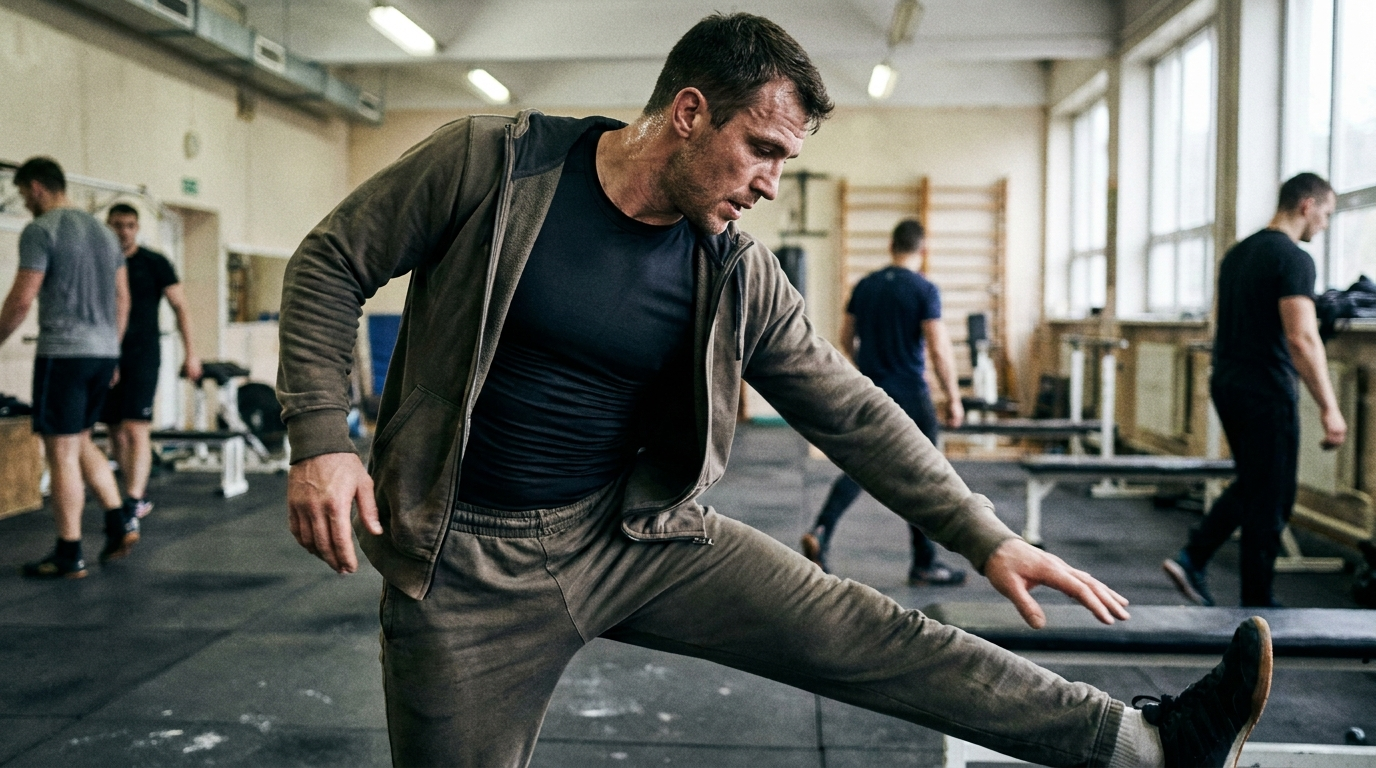
What NORDVEIL Actually Is
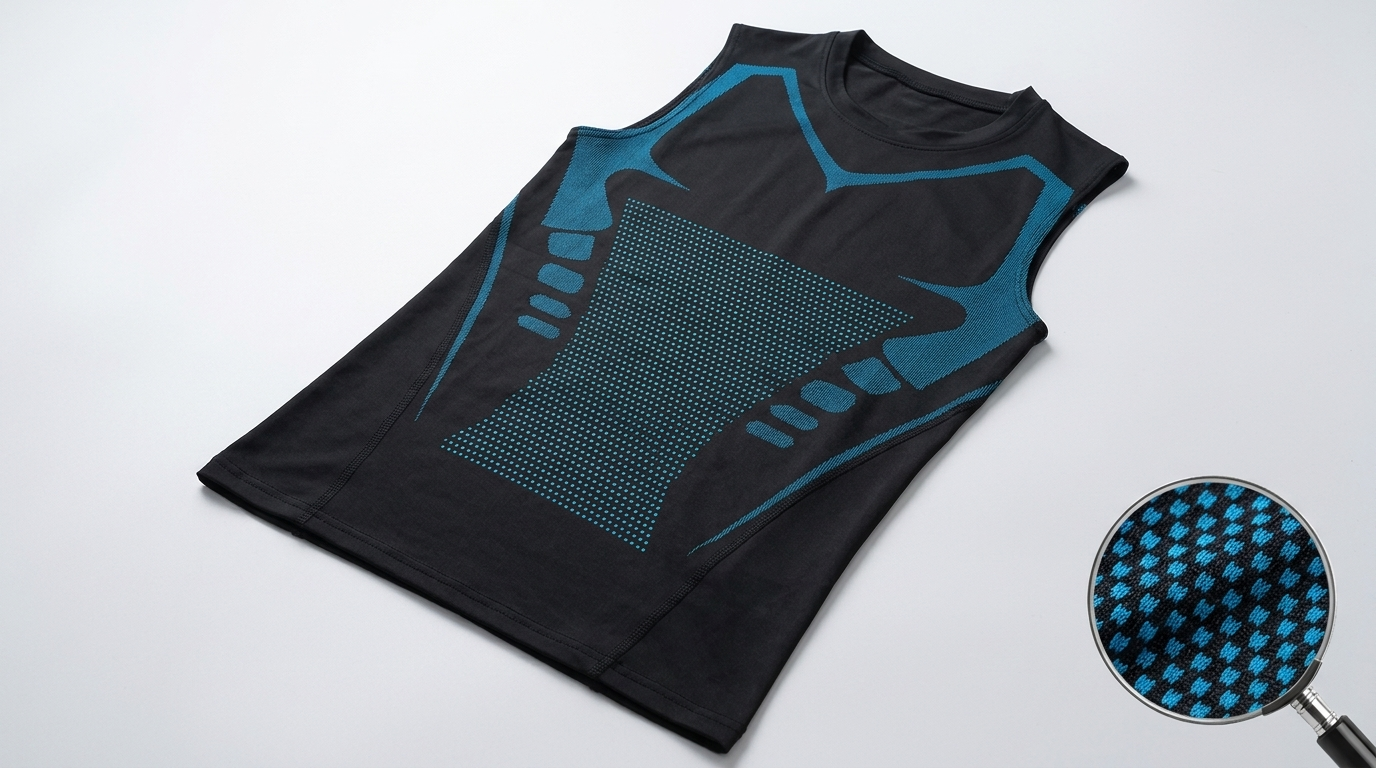
Mechanically, it's an engineered compression base layer for the torso — a tank built to be worn under work clothes for eight to ten hours at a stretch. The engineering priority is even, firm compression distributed across the trunk rather than concentrated pull at a few anchor points. Even pressure over a broad surface is what produces continuous feedback; localized pull just produces a pressure point you spend the day fighting.
In practice that means your shoulders are subtly and constantly reminded to sit back rather than drift, and your trunk is subtly reminded to stay engaged instead of collapsing into the chair back. Not held. Reminded. The difference matters, because a reminder trains a reflex and a brace replaces one.
The construction details are the boring ones that decide whether a garment gets worn: breathable panel zones through the high-sweat areas so it's survivable in July, a no-roll waistband that doesn't creep up and bunch at hour six, and a flat, seamless profile that reads as nothing at all under a dress shirt or a polo. It is not visible. Nobody will ask about it.
One honest expectation to set. The first two or three days, you will be aware of it. Men consistently report noticing it most in the first hours of wear. That awareness isn't a break-in period to be tolerated — it is the mechanism. That's the feedback loop switching back on. By day four most men stop registering it consciously and start registering the difference at the end of the day instead.
Worth stating plainly: NORDVEIL is a comfort and wear garment, not a medical device. It does not treat, cure, or diagnose anything. If you have a diagnosed spinal condition, persistent pain, or a recent injury, see a qualified professional first — this is not a substitute for care.
The $1,600 vs. $32.90 Problem
Your chair stays at the desk. This travels with your spine — every meeting, every car seat, every couch.
See the 2+1 free Pack Pricing →Single $32.90 · 2+1 free Pack $64.80 · 30-day guarantee
The 6 PM Test
Skip the reviews. Skip the specs. There's a cleaner way to settle this, and it takes one working week.
Here's the bet. Wear it for a full work week. Same job, same chair, same commute, same hours — change nothing else, because changing nothing else is what makes the result mean something. One metric only: how your back feels at 6 PM on your last workday, compared to how it felt at 6 PM one week earlier. Not how you look. Not how you feel on day one. The end of the week, 6 PM, lower back and the space between your shoulder blades.
If you can't tell the difference, send it back and take the refund. The 30-day guarantee exists precisely because most men don't send it back — a company that expected returns wouldn't structure the offer this way.
You already know what an untreated week feels like. The only new information available is what a different one feels like.
Summer Bundle Pricing — Limited
NORDVEIL Compression Tank
Feel The Power of Confidence, Shape & Control
Single
$32.90
One tank
2+1 free Pack · Best Value
$64.80
One per workday rotation
Less than one chiropractor visit — and you don't need an appointment.
- · 30-day guarantee, tied directly to the 6 PM test
- · The 2+1 free pack has sold out twice; restock takes weeks
- · Summer bundle pricing ends when the current run does
Sore back at the end of the week, or the test already running. Your choice.

The Math Was Never Close
The ergonomics industry has done extraordinarily well selling men objects that solve a problem for the eight hours they're touching them. That's not a scam, exactly. It's just a category error that happens to be very profitable — and you've been paying for it in four-figure increments while the ache kept its schedule.
Your chair cost $400 and stays in one room. Your desk cost $1,200 and stays in one room. The thing that actually follows your spine through the day costs thirty bucks and ships by Thursday.
The math was never close.
Daniel K. writes about workplace ergonomics, recovery, and the products sold to desk workers. This article is a sponsored advertorial produced in partnership with NORDVEIL. It describes general physiotherapy principles and expert consensus around proprioception and compression wear; it is not medical advice and does not describe treatment for any condition. Individual results vary. Consult a qualified professional for persistent or diagnosed back pain.